Passivation to AMS 2700 and ASTM A967 for Stainless Steel Machined Parts
Key points
- Passivation removes free iron and other surface contamination left by machining so the stainless steel can form its protective chromium oxide film. It is a cleaning and chemistry step, not a coating.
- AMS 2700 and ASTM A967 both cover the process. Each names methods or treatments and test practices, so the drawing must name the one it wants.
- Citric baths suit most austenitic and precipitation hardening parts. Free-machining grades and some martensitic grades need extra care.
- Passivate after all machining and cleaning, and ask for the test result, not only a certificate of conformance.
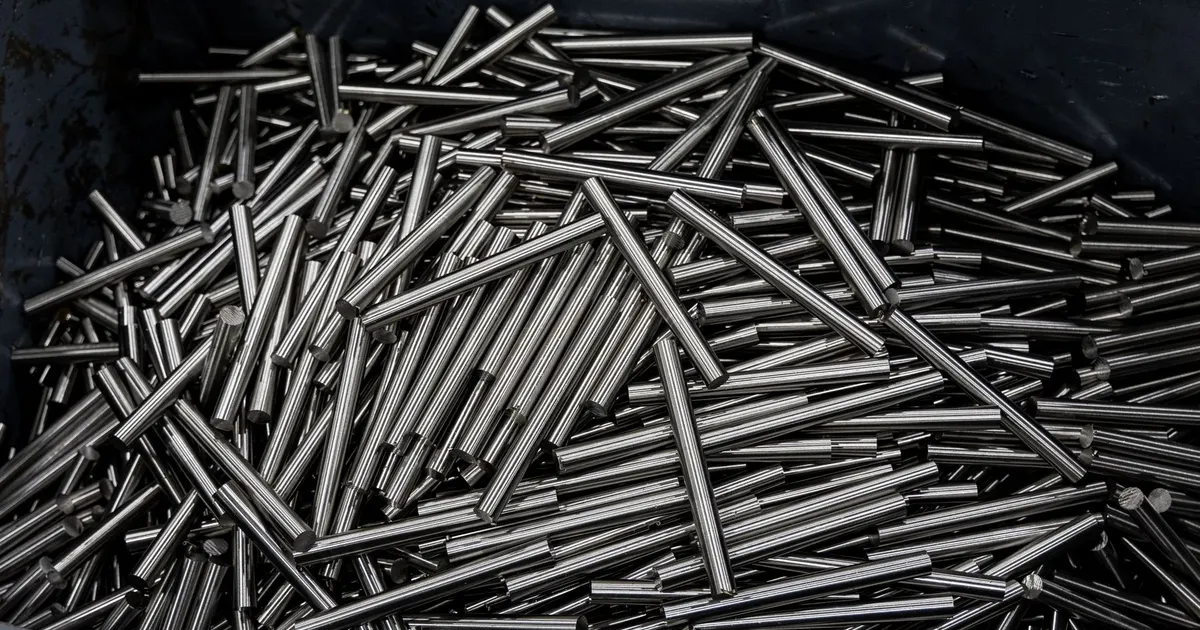
Passivation is the chemical treatment that restores the corrosion resistance of a stainless steel part after machining. Cutting tools, fixtures and handling leave tiny iron particles in the surface, and those particles rust. A bath of nitric or citric acid dissolves them and lets the chromium in the steel form a clean, continuous oxide film. On defense and aerospace drawings the process is usually called out as AMS 2700 or ASTM A967, and the note has to be specific to be enforceable.
What passivation does and does not do
Stainless steel resists corrosion because chromium reacts with oxygen to form a thin, self-repairing film on the surface. Machining disturbs that film and can contaminate the surface in two ways. Iron from cutting tools, chip tools and shop fixtures smears onto the part. Heat tint and oxide from welding or heat treatment sit on the surface. The free iron is the main problem, because it corrodes in moist air and makes the whole part look rusty even though the stainless underneath is sound.
Passivation removes the free iron by dissolving it in acid, and it leaves the chromium-rich surface to re-form its oxide film in air. It does not add a coating, does not change dimensions in any practical way and does not make a poor grade into a good one. It also does not remove heat tint, scale or embedded particles; those need pickling or mechanical cleaning first.
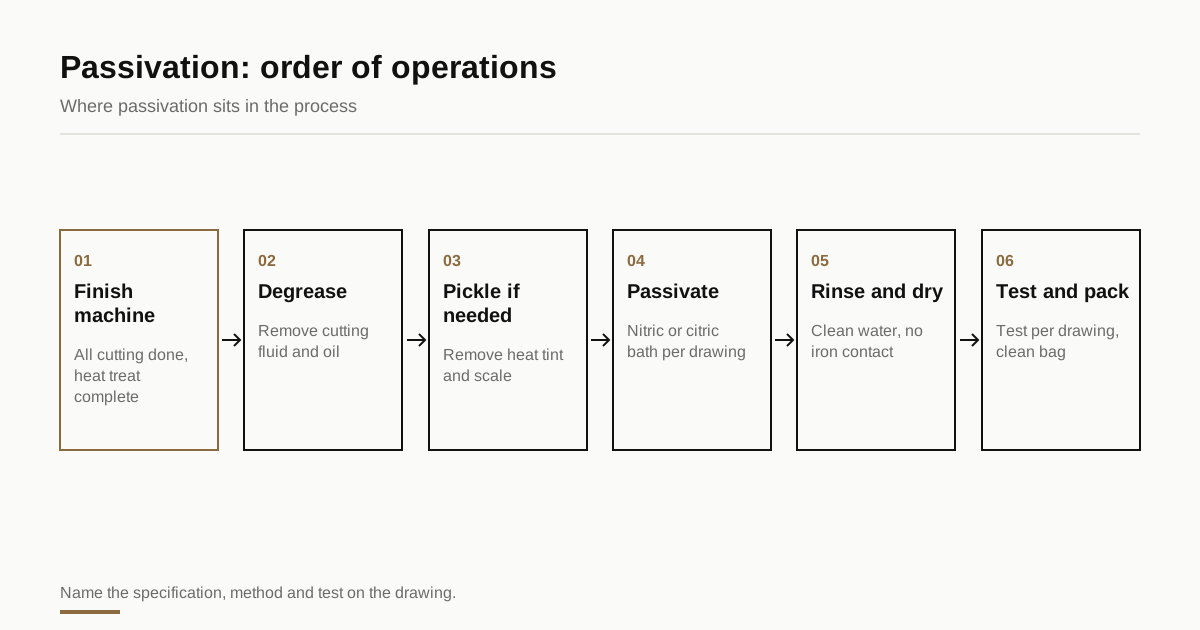
Parts must be clean before passivation. Cutting oil, coolant residue and fingerprints block the acid. A proper flow is machine, degrease, passivate, rinse and dry, with the documented process as the controlling record.
AMS 2700 and ASTM A967 side by side
Both specifications cover chemical passivation of corrosion-resistant steel. They are organized differently.
| Item | AMS 2700 | ASTM A967 |
|---|---|---|
| Issuer | SAE International (aerospace) | ASTM International (general industry) |
| Bath chemistry | Nitric acid and citric acid methods | Nitric treatments and citric treatments |
| How the process is named | Method and type (bath strength and temperature) | Treatment name, for example nitric or citric, with a number |
| Inspection | Defined tests and acceptance | Practices A to E: water immersion, high humidity, salt spray, copper sulfate, potassium ferricyanide |
| Typical use | Aerospace and defense programs | Commercial and industrial programs, also referenced in defense |
The practical point is that “passivate per AMS 2700” and “passivate per ASTM A967” are incomplete. Each leaves the method, type or treatment and the test open. A complete note names the specification, the bath chemistry, the type or treatment number and the test, for example “Passivate per AMS 2700, citric acid method, type confirmed with the processor” or “Passivate per ASTM A967, citric treatment, water immersion test”. Check the current revision of the specification for the correct method and type names, because they have been renumbered over time.
Nitric or citric: which bath
Nitric acid baths are the traditional choice. They work on almost all grades and have a long history. Citric acid baths are now widely used because they are easier to handle, easier to dispose of and gentler on some grades. They also avoid the use of strong oxidizing acid in the shop.
General guidance, to confirm with the processor:
- Austenitic grades (304, 316, 321): nitric or citric both work. Citric is common.
- Precipitation hardening grades (17-4 PH, 15-5 PH): nitric or citric, with attention to the heat treatment condition. See the guide to 17-4 PH conditions for how the aging temperature matters.
- Martensitic grades (410, 420, 440C): these are more sensitive. Strong nitric baths can cause flash attack on some. Citric is usually preferred, and the processor needs to know the grade and hardness.
- Free-machining grades (303, 416): sulfur or selenium inclusions can be attacked. Specifications limit the treatments allowed for these grades, and the processor must know the grade before choosing a bath.
The material callout on the drawing and the mill certificate should match what the processor is told, so the right bath is selected. A passivation house that does not know the grade cannot protect against a bad outcome.
Order of operations on the shop floor
The sequence matters more than the bath.
- Rough machine. For heat-treatable grades such as 17-4 PH, rough machine in the solution annealed condition, then age.
- Finish machine. Remove all material that will be removed. Do not passivate and then cut again.
- Deburr and clean. Remove cutting fluid with an alkaline cleaner. A water-break-free surface is the target.
- Pickle if needed. Heat tint and scale from welding or heat treatment must come off first.
- Passivate. Bath, rinse, final rinse in clean water, dry.
- Test. Run the specified test on parts or on witness samples.
- Pack. Bag or wrap so the parts are not contaminated by handling or shipping.
Nothing that adds iron should touch the part afterward. Carbon steel tools, wire brushes and abrasive pads used on other materials contaminate stainless. Shops that handle both materials should use dedicated stainless tooling and racks.
If a part is plated or anodized later, passivation is usually not needed, but drawings should say so. Some processors passivate again after a late machining operation, such as a tapped hole added after heat treat, and they should be told when that is expected.
Tests and what they prove
The test requirements in the standards are meant to show whether free iron remains on the surface.
- Water immersion and high humidity: parts sit in water or humid air for a defined time and are inspected for rust. Simple, but it takes time.
- Salt spray: a more severe version for parts that will see salt.
- Copper sulfate: a quick chemical test that shows free iron by copper deposition. Intended for some grades only.
- Potassium ferricyanide: a sensitive test that turns blue where free iron is present. Intended for specific grades.
Each practice has a list of grades it applies to. A test that is not suited to the grade can fail a good part or pass a bad one, so confirm that the test named on the drawing fits the alloy. Ask for the test results or the processor’s test log in addition to a certificate of conformance. A certificate says the process was done. A test result says it worked.
What to ask the supplier
When you send an RFQ for stainless parts that need passivation, include:
- The specification, revision, method or treatment and the test, spelled out.
- The alloy and heat treatment condition so the bath can be chosen correctly.
- Whether the part will be welded, plated or assembled later.
- Where the passivation is performed, and whether the supplier uses an outside processor.
- Which records you need: a processor certificate with lot numbers, test results and the bath control record if your program asks for it.
Ask the supplier how the baths are maintained, how often the solution is checked and how it prevents contamination between jobs. A good processor answers these questions without difficulty. milcnc.com does not claim approval or accreditation for any supplier, so confirm what your contract requires directly.
Common failures and what causes them
Most passivation rejects trace back to a short list of causes. Flash attack shows up as a dull, etched or darkened surface and usually means the bath was too strong, too hot or left too long for the grade, or that a martensitic part sat in a nitric bath it could not tolerate. Rust spots after a humidity test mean free iron remained, which points to poor cleaning, a bath that was out of control or contamination from carbon steel tooling after the process. Staining at joints and crevices means rinse water was trapped, so drain holes and open geometry help. Heat tint that survives the bath means pickling was skipped.
Good suppliers prevent these with bath records, test coupons run with each lot and separate racks for stainless. When you review a first article, look at the processor certificate and the test record together. A certificate with no test result tells you the process was scheduled, not that it worked.
Export classification note
Passivation is a finish and does not change export control status. A stainless bracket can be EAR99 or controlled depending on what it is, and the buyer owns classification. milcnc.com does not accept ITAR-controlled technical data and does not accept other EAR-controlled data without the buyer’s licence. See the export compliance policy for the scope.
Next step
Send the STEP model and PDF drawing with the passivation note written in full, the alloy and condition, quantities and the export classification statement through the RFQ form. We sign an NDA, screen the package and match it with up to 3 CNC suppliers, with a focus on Vietnam. Replies arrive within 24 business hours of a complete RFQ, and you contract directly with the supplier you choose. The capabilities page lists the finishes and materials routinely handled.
Sources
- Wikipedia: Passivation (chemistry)
- ASTM A967: Standard Specification for Chemical Passivation Treatments for Stainless Steel Parts
General information, not legal or engineering advice. Check the current revision of every standard and clause.