17-4 PH Stainless From H900 to H1150: How to Pick the Heat Treat Condition
Key points
- 17-4 PH is bought in the solution-annealed condition (Condition A) and aged to H900, H925, H1025, H1075, H1100 or H1150. The number is the aging temperature in degrees Fahrenheit.
- Lower aging temperature gives higher strength and hardness. Higher aging temperature gives better toughness and stress corrosion resistance.
- H1025 is a common middle choice. H900 is the strongest but least tolerant of corrosive environments under stress.
- Machine in Condition A where possible, age after rough machining and allow for the small, predictable dimensional change from aging.
17-4 PH is a stainless steel that can be heat treated to very high strength with a single low-temperature aging step. That makes it a favorite for pins, shafts, fittings, gears, housings and structural parts in defense and aerospace hardware. The catch is the condition. The same bar can be soft or very hard, tough or brittle in the wrong environment, depending on a heat treatment number that must be on the drawing. This guide compares the common conditions and sets out how to choose and how to machine.
What 17-4 PH is
17-4 PH is a martensitic, precipitation-hardening stainless steel, UNS S17400, with about 17 percent chromium and 4 percent nickel plus copper. It is delivered in the solution-annealed state, called Condition A. A single aging treatment at a moderate temperature precipitates copper-rich particles that harden the steel. No quench is required for aging, so distortion is small compared with quench and temper steels.
The grade is magnetic and has corrosion resistance between 304 and 316 in most environments. It is available as bar to AMS 5643 and ASTM A564 type 630, as plate and forgings under related documents. See the guide to AMS and ASTM callouts for how those documents differ.
The conditions and what they give
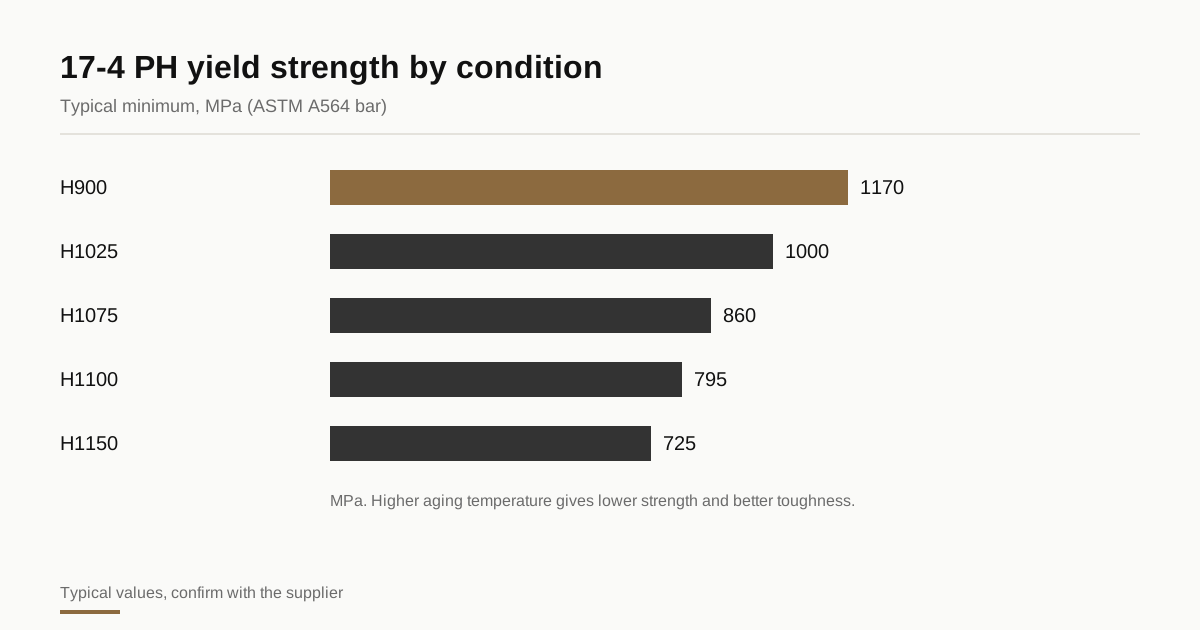
The aging temperature sets the properties. The values below are typical minimums from ASTM A564 for bar, shown for orientation. Check the specification and the heat certificate for the numbers that apply to your product.
| Condition | Aging temperature | Tensile strength, min | Yield strength, min | Elongation, min | Hardness, min |
|---|---|---|---|---|---|
| H900 | 482 C (900 F) | 1310 MPa (190 ksi) | 1170 MPa (170 ksi) | 10 percent | 40 HRC |
| H925 | 496 C (925 F) | 1170 MPa (170 ksi) | 1070 MPa (155 ksi) | 10 percent | 38 HRC |
| H1025 | 552 C (1025 F) | 1070 MPa (155 ksi) | 1000 MPa (145 ksi) | 12 percent | 35 HRC |
| H1075 | 579 C (1075 F) | 1000 MPa (145 ksi) | 860 MPa (125 ksi) | 13 percent | 32 HRC |
| H1100 | 593 C (1100 F) | 965 MPa (140 ksi) | 795 MPa (115 ksi) | 14 percent | 31 HRC |
| H1150 | 621 C (1150 F) | 930 MPa (135 ksi) | 725 MPa (105 ksi) | 16 percent | 28 HRC |
The trend is plain. Each step up in aging temperature costs strength and hardness and buys ductility and toughness. A double-aged variant, H1150-D, ages twice for further stress relief and improved toughness. Aging times are set by the specification and are usually about one hour for H900 and four hours for the higher conditions.
Matching the condition to the job
H900. The strongest and hardest. It suits parts that need the highest strength in a benign environment: pins, fasteners, tooling and shafts in dry service. It has the lowest toughness and the highest sensitivity to stress corrosion cracking, so many programs restrict it.
H1025. A common general choice. It keeps most of the strength and gives much better toughness and corrosion resistance. Many aerospace and defense drawings choose H1025 as the default for structural fittings.
H1075 and H1100. Middle conditions with more toughness. Used where fracture resistance matters or where the part is stressed in moist air.
H1150 and H1150-D. The most ductile and the most resistant to stress corrosion cracking. Suited to parts under sustained tension in marine or other corrosive environments, such as fittings and valve parts. Strength is lower, so section sizes may need to grow.
If you are unsure, ask what the load case and environment are. A part loaded in tension continuously, in humid or salt air, calls for a higher aging temperature. A part with a short, protected life and a need for maximum hardness can use H900. The buyer’s engineering owns that decision and should write it on the drawing. A supplier cannot choose it for you.
Machining order and distortion
17-4 PH has a predictable but real dimensional change on aging. It contracts slightly, by a few tenths of a thousandth of an inch per inch, with the amount depending on the condition. Because the change is small and consistent, it is manageable.
A common sequence for parts with close tolerances:
- Rough machine in Condition A. The metal is softest (around 33 HRC maximum for solution-annealed bar) and tool life is best.
- Age to the specified condition. Heat treatment is done by an outside shop or in-house furnace, with a record.
- Finish machine or grind. Cut or grind to final size, leaving only a small stock allowance after rough machining.
- Passivate. See AMS 2700 and ASTM A967 passivation.
- Inspect. Include hardness testing on the finished part or on a test coupon aged with it.
If the part cannot be finish machined after aging, for example because of a deep thread or a small bore, leave enough stock for the aging shift, or specify that the part be machined from bar already supplied aged. Machining aged material is slower, uses carbide and rigid setups and wears tools faster. The cost is higher, and the quote should say which route is expected.
Threads are best cut before aging in Condition A, then checked after aging, because a tapped thread can shrink slightly out of tolerance. Plan a final thread check or a chase after aging for tight classes.
Hardness testing and records
Hardness is the quick check on whether the part reached the right condition. Request:
- A hardness reading, usually Rockwell C, for each lot or each heat treat load, on the part or on a coupon.
- The heat treat certificate showing the furnace, temperature, time and the specification followed.
- The furnace calibration record, if the contract requires it (aerospace heat treating often follows a pyrometry standard such as AMS 2750).
- The mill certificate for the bar, showing it was supplied in Condition A.
If the drawing demands a tensile test, specify where the test bar is taken and whether it is aged with the parts. Tensile testing of finished parts is rarely possible, so lot-based coupons are used.
Common mistakes
- No condition on the drawing. “17-4 PH” alone leaves the supplier to choose.
- Over-specifying H900 where H1025 would do, giving lower toughness and more stress corrosion risk for no benefit.
- Welding after aging. Welding a hardened part changes its microstructure. Welded parts need re-solution treatment and re-aging, which distorts them.
- Plating or coating without hydrogen embrittlement relief. Hard conditions are more sensitive, so ask for baking after any plating.
- Forgetting aging shrinkage on tight bores. Plan stock or a finish pass.
Corrosion, stress corrosion and hydrogen
Corrosion resistance depends on the condition as well as the grade. After aging, 17-4 PH resists general corrosion in atmospheric and mild chemical service about as well as 304 and in some environments less well than 316. Chloride environments are the main concern, since pitting and crevice corrosion can occur in warm, salty conditions regardless of condition.
Stress corrosion cracking is the failure mode that drives condition choice. A part under sustained tensile stress in a moist or chloride environment can crack with little warning, and H900 is the most susceptible condition. Moving to H1025, H1075 or H1150 raises the margin at the cost of strength. Some industry specifications restrict the allowed conditions for pressure-containing parts in certain services, so check the specification that applies to your program.
Hydrogen embrittlement is a second concern for the harder conditions. Plating, acid pickling and cathodic protection can introduce hydrogen. If any of these processes touch a 17-4 PH part in the H900 or H1025 conditions, ask for a baking step and a record of it. Passivation is normally an oxidizing process and is not a hydrogen concern when run to specification.
Export classification note
The alloy and heat treatment condition do not set export control. The part and its design do. The buyer owns classification. milcnc.com does not accept ITAR-controlled technical data and does not accept EAR-controlled data without the buyer’s licence. See the export compliance policy for the scope.
How to send the RFQ
Put the full callout on the drawing: alloy, specification and revision, aging condition, hardness requirement, test coupon rule and certificate level. Include the machining sequence if you have a preference. Send it with the STEP model and export classification statement through the RFQ form. We sign an NDA, screen the package and match it with up to 3 CNC suppliers, with a focus on Vietnam. Quotes arrive within 24 business hours of a complete RFQ, and you contract directly with the supplier you choose.
Sources
General information, not legal or engineering advice. Check the current revision of every standard and clause.