AMS vs ASTM Material Specs: How to Read the Material Callout on a Defense Drawing
Key points
- AMS specifications come from SAE and are written for aerospace. ASTM specifications are general industrial standards. The same alloy can be bought to either, with different requirements.
- AMS callouts usually add tighter chemistry, melt practice, heat treatment, testing, cleanliness and certification than the ASTM equivalent.
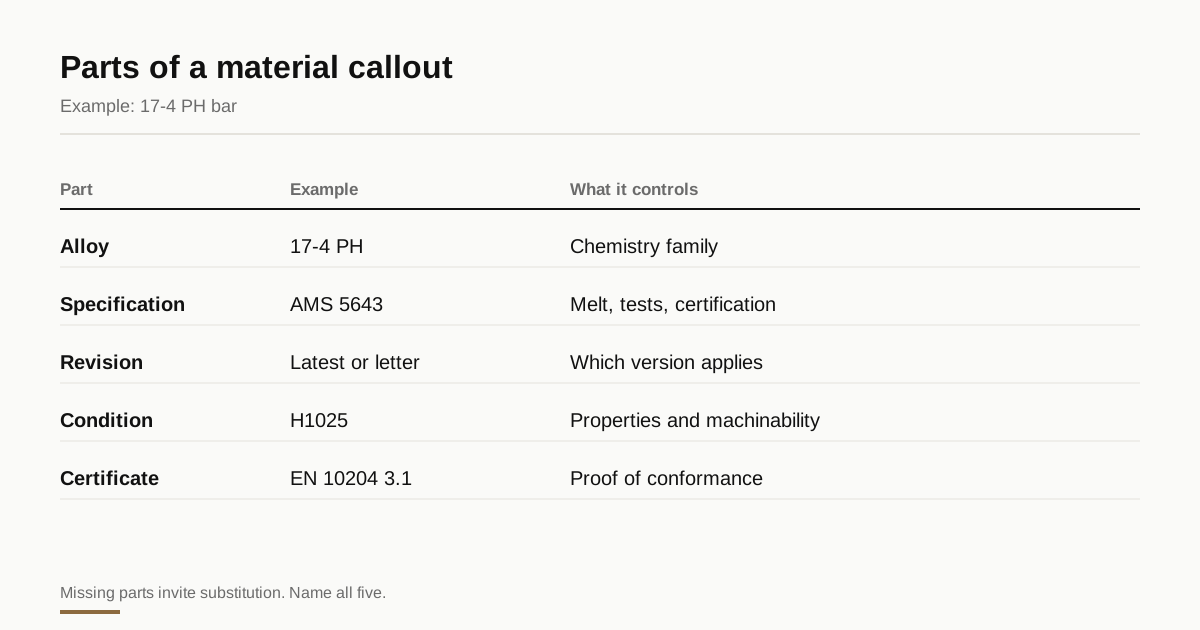
- A callout has up to five parts: alloy, specification, revision, condition or temper and any supplementary requirements. Missing parts invite substitution.
- 'Or equivalent' is not a blank cheque. Say who approves a substitute and what evidence the approval needs.
The material callout on a defense drawing is a short line with a lot of meaning. “17-4 PH per AMS 5643, H1025” tells a supplier the alloy, the document, the heat treatment and, by implication, the test and certificate requirements. The same alloy bought under a different document can be cheaper, quicker to source and technically non-compliant. This guide explains how AMS and ASTM specifications differ and how to read, write and enforce a material callout.
Who writes AMS and ASTM and why it matters
AMS documents are issued by SAE International, mostly by committees for aerospace materials. They exist because aircraft and defense hardware needs controls that general industry does not. An AMS bar specification typically tells the producer how to melt the steel, how much it may be reduced, what to test and how to certify.
ASTM documents are issued by ASTM International through consensus committees for general industry. They cover a huge range of products. Their requirements suit most commercial uses and set a baseline. They are usually shorter on process control and certification.
Many older US military material specifications were cancelled and replaced by AMS or ASTM documents. A drawing that cites an old military specification is not wrong, but the supplier must know the current replacement. Ask for the replacement document and for written agreement on it before the quote.
The practical result: if the drawing says AMS, you get the process controls. If it says ASTM, you get the product description. If it says “17-4 stainless” with no document, you get whatever the supplier can buy.
Same alloy, different documents
The table lists common pairs. In each, the alloy is the same family but the documents differ in scope and strictness. Check the current revision of each document for the details.
| Alloy | Typical AMS reference | Typical ASTM reference | What differs |
|---|---|---|---|
| 17-4 PH bar | AMS 5643 | ASTM A564 type 630 | AMS adds melt practice, test frequency, certification |
| 4340 bar | AMS 6414 or AMS 6415 | ASTM A29 grade 4340 | AMS sets melt method (vacuum remelt or air melt), cleanliness, grain and test locations |
| Ti-6Al-4V plate | AMS 4911 | ASTM B265 grade 5 | AMS sets microstructure, alpha case and test directions |
| Ti-6Al-4V bar | AMS 4928 | ASTM B348 grade 5 | AMS sets heat treatment, microstructure and test frequency |
| 6061 plate | AMS-QQ-A-250/11 | ASTM B209 | Similar content; check which references are current |
Where the alloy is the same, the AMS version usually costs more and takes longer to source, because fewer mills qualify and lots are tested more. For safety-critical parts the control is worth the cost. For a non-critical bracket on ground equipment, ASTM may be enough. The drawing, or the buyer’s engineering, decides.
Reading a callout, piece by piece
A complete callout has parts. Here is an example:
“MATERIAL: TITANIUM ALLOY 6AL-4V, PLATE, ANNEALED, PER AMS 4911, LATEST REVISION. CERTIFICATION PER EN 10204 TYPE 3.1.”
| Part | Example | What it controls |
|---|---|---|
| Alloy or UNS number | Ti-6Al-4V | Chemistry family |
| Product form | Plate | Grain flow, test directions, size range |
| Condition or temper | Annealed | Mechanical properties, machinability |
| Specification | AMS 4911 | Requirements for chemistry, properties, testing |
| Revision | Latest or letter | Which version of the requirements |
| Supplementary requirements | EN 10204 type 3.1 | Certification level, origin, extra tests |
If any part is missing, the supplier fills the gap and not always the way you expect. A callout with no condition for an aging alloy could be supplied soft or hard. A callout with no product form may arrive as bar when plate was intended, with a different grain direction. A callout with no revision may be supplied to whichever revision the stockist holds.
UNS numbers (for example S17400 for 17-4 PH) are useful for identifying the alloy across specifications. They do not replace the specification callout, because the UNS number does not say how the material was made or tested.
What AMS usually adds over ASTM
The details vary by document, but AMS specifications commonly add some of these.
- Melt practice. Air melt, vacuum induction melt, vacuum arc remelt or electroslag remelt. Cleaner steel resists fatigue better.
- Tighter chemistry. Narrower ranges on carbon, sulfur, phosphorus or residual elements.
- Grain and microstructure. Limits on grain size, banding, alpha case or inclusion rating.
- Heat treatment and verification. Defined cycles and hardness or tensile checks per lot.
- Test location and direction. Where the coupons are taken, and in which grain direction.
- Quality and certification. Mandatory certificate content and traceability to the heat.
- Non-destructive testing. Ultrasonic or other inspection on some products.
If you are comparing quotes, check which document each one assumes. A supplier offering a lower price may be quoting to ASTM when the drawing says AMS.
“Or equivalent” and substitutions
Drawings sometimes say “or equivalent”. It is a loose phrase, and it causes disputes. A fair reading is that an equivalent material must meet or exceed every requirement of the cited specification, and that the buyer must approve the substitution. Without both conditions, a substitution is an unapproved deviation.
To keep control:
- State in the RFQ that substitutions are not allowed unless approved in writing by the buyer’s engineering.
- If substitutions are allowed, say what evidence is required: a side-by-side comparison of the specification requirements, the mill certificate and test data.
- Do not accept a cross-reference chart as proof. Charts are summaries, and they miss details.
- Ask the supplier to name the document and revision it quotes against.
When a drawing cites a cancelled specification, treat the replacement as a change that needs the buyer’s agreement. See the guide to material traceability and mill certs for how the certificate proves the material was made to the named document.
Common mistakes
- Calling out the alloy only. “17-4” is not a specification.
- Mixing document families. For example, naming an AMS specification and an ASTM condition code together, which may not exist in either.
- Omitting the condition. For aging steels and titanium, the condition drives properties and machining.
- No revision. Leaves the interpretation open.
- Assuming the stockist’s stock meets AMS. Many commercial stock bars are made to ASTM and sold under an alloy name. The certificate must name the AMS document.
- Skipping the certificate review. The certificate states the specification the material meets. Read it.
A worked example: checking a quote against the drawing
Suppose a drawing calls for 4340 steel bar per AMS 6414 in the normalized and tempered condition with a type 3.1 certificate. Three quotes arrive. The first lists “4340 steel bar” with no document. The second lists 4340 to ASTM A29 with a mill certificate. The third lists AMS 6414 with melt practice stated and the certificate wording quoted from the specification. Only the third matches the drawing. The first leaves everything open and the second changes the document, which changes melt practice, cleanliness limits and test frequency even though the alloy name is identical.
The fix is simple. Ask every supplier to restate the callout in its own quote, word for word, including the revision, and to attach a sample certificate from its stock source if it already holds the material. If the stock source cannot provide an AMS certificate, the supplier needs a mill order, which changes the lead time. Do this before awarding the order. It costs a few emails and removes the most common source of a non-conforming lot.
Where to find the current documents
AMS documents are sold by SAE International and ASTM standards are sold by ASTM International, and both organizations publish revision histories. Many suppliers keep a subscription for the documents they use most. If your supplier does not own the document named on your drawing, either the buyer provides a copy under the terms of the contract or the supplier buys it, and the quote should say which. Material specifications also reference other documents, such as test methods and heat treatment standards, so a single callout can pull in several more. Ask the supplier to confirm that it has access to the full set before production.
Export classification note
The material callout does not set export control. The part and its use do, and the buyer owns classification. milcnc.com does not accept ITAR-controlled technical data and does not accept EAR-controlled technical data without the buyer’s licence. See the export compliance policy. Some materials, such as titanium, are also specialty metals under some US defense contract rules, which affects sourcing and not export status.
Writing it into the RFQ
Put the full material callout on the drawing and repeat it in the RFQ: alloy, product form, condition, specification, revision, certificate level and substitution rule. Send the STEP model, PDF drawing and export classification statement through the RFQ form. We sign an NDA, screen the package and match it with up to 3 CNC suppliers, with a focus on Vietnam. Quotes arrive within 24 business hours of a complete RFQ, and you contract directly with the supplier you choose. The capabilities page lists the materials routinely handled.
Sources
General information, not legal or engineering advice. Check the current revision of every standard and clause.