CARC Coating Over Machined Parts: Surface Prep, Primer and Topcoat Specs
Key points
- CARC (chemical agent resistant coating) is a system, not a paint: a pretreatment, an epoxy primer and a polyurethane topcoat, each with its own specification.
- Aluminum normally gets chemical film as pretreatment and steel gets a phosphate or similar. The primer must be compatible with both the pretreatment and the topcoat.
- Masking threads, bores, grounding faces and bearing seats must be defined on the drawing before the coating step.
- Many buyers have the machined part delivered with pretreatment or primer only and apply the CARC topcoat in a qualified domestic facility.
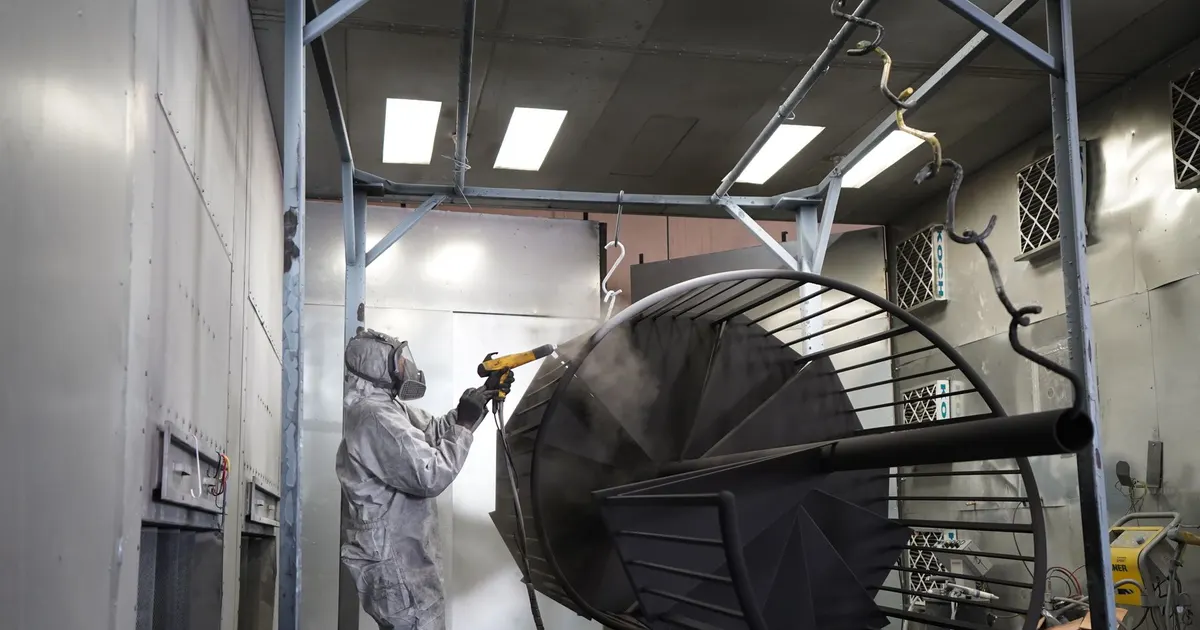
CARC is the polyurethane coating system used on military ground vehicles and ground equipment to resist weather, fuel, decontamination chemicals and handling. On a machined part, CARC is the last finish step, and it works only if the steps before it were done correctly. The surface must be clean, pretreated with the right conversion coating, primed with a compatible epoxy and topcoated within the allowed time. A machined bracket with perfect dimensions can still fail if the prep was wrong, because paint that does not bond peels in the field.
What CARC is as a system
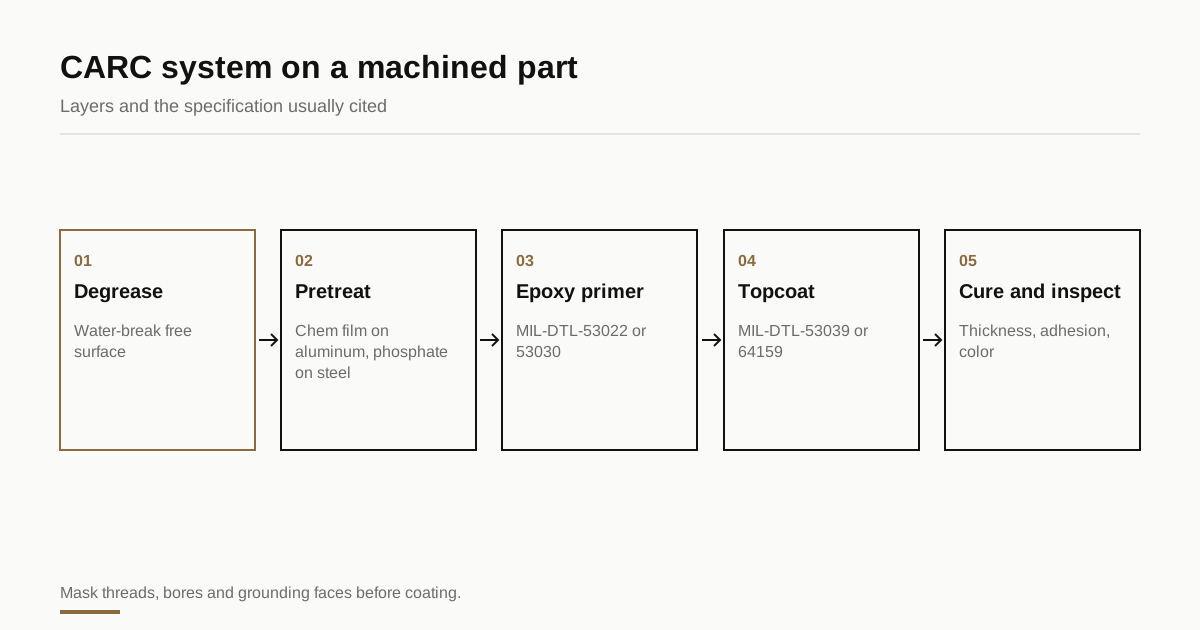
CARC is a three-layer system, and each layer has a job.
- Pretreatment. A thin conversion coating on bare metal. It improves adhesion and slows corrosion under the paint.
- Primer. A two-component epoxy primer that bonds to the pretreatment and gives the topcoat something to hold.
- Topcoat. An aliphatic polyurethane that resists chemicals, weather and wear, and gives the final color and low gloss.
The specifications most often cited are:
| Layer | Common specification | Notes |
|---|---|---|
| Aluminum pretreatment | MIL-DTL-5541 chemical film | Type and class per the drawing |
| Steel pretreatment | Phosphate or other treatment named on the drawing | Check the program for the approved process |
| Epoxy primer | MIL-DTL-53022 (solvent) or MIL-DTL-53030 (water-dispersible) | Must match the topcoat family |
| Topcoat, solvent | MIL-DTL-53039 | Single component, aliphatic polyurethane |
| Topcoat, water-dispersible | MIL-DTL-64159 | Two component, lower solvent content |
Check the current revision and the qualified products list named by the contract. The coating products themselves must come from the approved source list if the contract requires it, and a supplier cannot claim approval it does not have. milcnc.com does not claim any coating approval for any supplier.
Surface preparation before the pretreatment
Preparation is where most failures start. The sequence on a machined aluminum part usually runs:
- Degrease to remove cutting fluid, oil and fingerprints. Water-break testing shows when the surface is clean.
- Deburr and edge break. Paint pulls away from sharp edges, so call out an edge break of 0.2 to 0.5 mm as a typical figure.
- Etch or deoxidize if the process requires it, to remove the natural oxide.
- Apply chemical film (see MIL-DTL-5541 Type I and Type II). Rinse and dry.
- Prime within the time limit after pretreatment. The chemical film must stay clean and dry, and long waits require reprocessing.
On steel parts, grit blasting to a defined profile and a phosphate treatment are common. Grit blast media must not leave iron on aluminum, and aluminum and steel parts should be processed in separate lots to avoid cross-contamination.
Do not anodize aluminum and then CARC it unless the program allows it. Anodized surfaces can need different primers or surface treatment, and the combination must be stated on the drawing.
Primer and topcoat application
The epoxy primer is mixed in two parts with a pot life, so the booth must apply it within the window. It is sprayed to a dry film thickness range in the specification, then flashed off and cured to the point where the topcoat will bond. Topcoat recoat windows are limited: too soon traps solvent, too late can need scuffing and a tie coat.
Typical facts to confirm with any applicator:
- Film thickness per layer set by the specification in thousandths of an inch (mils). The total system is usually a few mils, which is about 75 to 125 micrometers for the full stack.
- Cure schedule. The coating dries quickly to handle but reaches full chemical resistance after days at room temperature. Parts should not be packed tightly or stacked while still soft.
- Color and gloss per the color standard on the drawing. CARC is a low gloss, near matte finish for most colors.
- Spray equipment and ventilation. Aliphatic polyurethanes contain isocyanates and need appropriate protection and ventilation, which is another reason many machine shops do not spray them.
An inspection record should show film thickness readings, adhesion tests where required and cure time. Adhesion is typically tested by tape or cross-hatch method on test panels processed with the lot.
Masking and drawing notes
The coating adds thickness and insulates. Both can break a part. Decide up front which features are masked and write it on the drawing.
- Threads: mask or chase after coating. Painted threads gum up and gauge incorrectly.
- Bores and bearing seats: mask. Paint changes the fit.
- Dowel holes and locating pins: mask, and note the pin fit before coating.
- Grounding and bonding faces: mask and keep bare chemical film (Class 3) for conductivity.
- Mating flat faces: mask or state that dimensions apply after coating.
- Gasket sealing faces: mask unless the sealing standard specifies otherwise.
A drawing note could read: “Pretreat per MIL-DTL-5541 Type II Class 1A. Prime and topcoat per customer specification. Mask threads, bores A and B and grounding face C. Dimensions apply before coating on masked features.” The note makes sure the supplier and the coater read the same intent. If the machining supplier hands the part to an outside coater, the coater needs the same drawing or a masking diagram.
Who applies the coating
The coating step has three common arrangements.
- Supplier ships bare or pretreated, buyer coats. The buyer controls the qualified coating and the final color. This is the most common arrangement for defense contracts with strict coating rules.
- Supplier ships primed, buyer applies topcoat. The part is protected during shipping and the buyer completes the finish.
- Supplier applies the full system. Possible when the supplier or its subcontractor can document the process and the contract allows it.
Shipping bare aluminum with only chemical film is fine when the parts are packaged well. Shipping bare steel needs rust protection, such as a preservative oil or vapor corrosion inhibitor paper, which must be removed before painting.
Ask which arrangement the contract requires. If it requires the full system, require records of the coating materials used (product, batch, expiry date) and of thickness readings.
Inspection of coated parts
Coated parts are inspected differently from machined parts. Dimensional checks on masked features come first, since they confirm that masking worked. Film thickness is measured with a magnetic or eddy-current gauge at several points per part, with readings recorded against the minimum and maximum in the specification. Adhesion is tested on panels or on a non-functional area by tape or cross-hatch methods. Color and gloss are compared with a standard chip under defined lighting, because low-gloss colors look different under shop lights and daylight.
Appearance defects are common in practice: runs, sags, orange peel, dry spray, fish eyes from silicone contamination and pinholes over porous castings. Define the visual acceptance standard before the coating step, for example which surfaces are visible and which defects are allowed on hidden faces. A drawing that says only “paint per specification” leaves the argument for later. Also state how coated parts are packed. Cured CARC resists chemicals well, but soft or uncured film marks easily, so parts should be separated by clean paper or foam and not stacked until the supplier confirms the cure.
Export classification note
CARC systems are a finish used on military ground equipment, but a part’s export status depends on the part itself and not on its coating. A part designed for a military vehicle may be controlled under a 600-series ECCN or on the USML, and the buyer must classify it. milcnc.com does not accept ITAR-controlled technical data and does not accept EAR-controlled technical data without the buyer’s licence. We match only commercial-grade and dual-use components. See the export compliance policy.
Sending a coated part for quoting
Send the STEP model and PDF drawing with the pretreatment, primer and topcoat specifications written in full, the color reference, masking diagram, who applies each layer and what records you need. Include quantity breaks and your export classification statement in the RFQ form. We sign an NDA, screen the package and match it with up to 3 CNC suppliers, with a focus on Vietnam. You receive quotes within 24 business hours of a complete RFQ and contract directly with the supplier you pick. For the same kind of finishing questions on ground equipment, see ground support equipment machining.
Sources
General information, not legal or engineering advice. Check the current revision of every standard and clause.