7075-T6 vs 6061-T6 Aluminum for Mil-Spec Machined Parts: Strength, Cost and Limits
Key points
- 7075-T6 has roughly twice the yield strength of 6061-T6, with slightly higher density and a higher price. 6061-T6 welds, resists corrosion better and costs less.
- 7075-T6 is not suited to fusion welding and is prone to stress corrosion cracking in the short transverse direction; 7075-T73 tempers trade some strength for better resistance.
- Pick by the governing load case, not by habit. Many brackets and housings are stiffness-limited, and 6061 is stiff enough.
- Name the alloy, temper and specification on the drawing. 'Aluminum' alone is not a callout.
7075-T6 and 6061-T6 are the two aluminum alloys that appear most often on mil-spec and defense-adjacent machined parts. They look the same, machine in much the same way and often get swapped on a quote. They are not interchangeable. 7075 gives about twice the strength and costs more, and it brings corrosion, welding and stress corrosion limits that 6061 does not have. Picking the right one is a design decision that is better made on the drawing than at the machine.
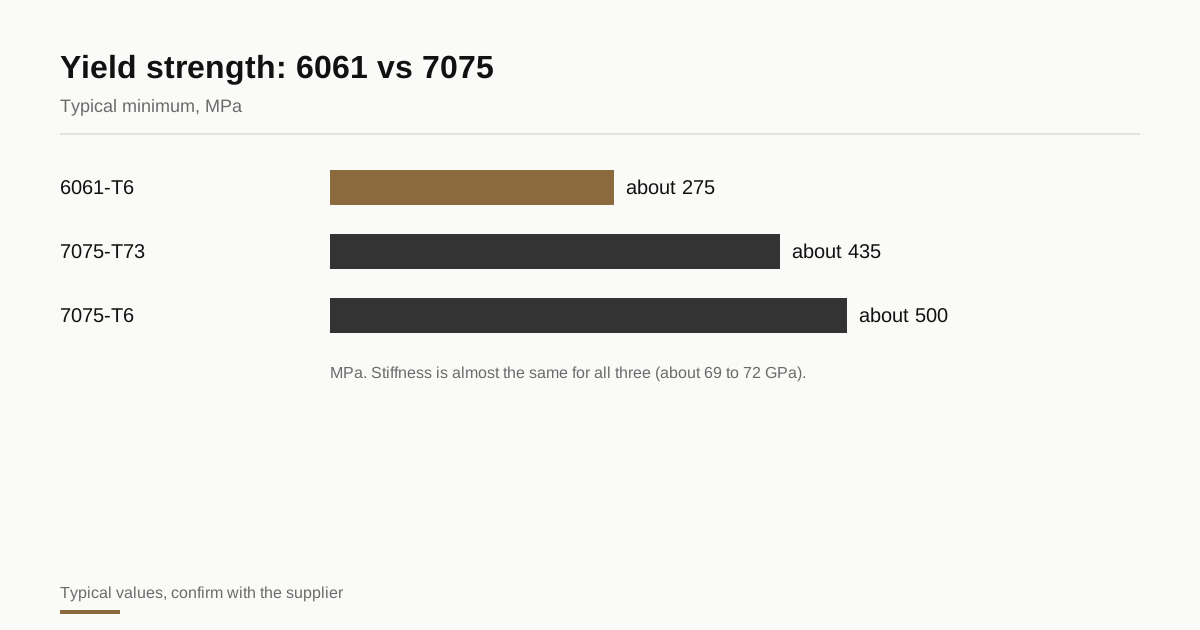
Typical properties side by side
The figures below are typical minimums for plate or bar in the T6 temper. They vary with product form, thickness and specification, so confirm against the specification that applies to your drawing.
| Property | 6061-T6 | 7075-T6 |
|---|---|---|
| Yield strength | about 275 MPa (40 ksi) | about 500 MPa (73 ksi) |
| Tensile strength | about 310 MPa (45 ksi) | about 570 MPa (83 ksi) |
| Elongation | about 12 percent | about 11 percent |
| Density | 2.70 g/cm3 | 2.81 g/cm3 |
| Modulus of elasticity | about 69 GPa | about 72 GPa |
| Fusion weldability | Good | Not recommended |
| General corrosion resistance | Good | Fair |
| Stress corrosion cracking risk | Low | Higher in T6, lower in T73 |
| Relative material cost | Baseline | Typically higher, often by tens of percent |
The most important line is the modulus. Both alloys have nearly the same stiffness. A bracket designed to limit deflection gets no benefit from 7075, because it will deflect about the same. 7075 helps where the part is limited by strength: high-stress joints, thin ribs with peak loads, pins and lugs.
When 6061-T6 is the right answer
6061-T6 is the default for most machined housings, brackets, plates and fixtures because it does the job at a lower price. Choose it when:
- The part is stiffness-limited. Enclosures, base plates and frames fit here.
- Welding is needed. Frames and weldments with machined interfaces are 6061. Heat-affected zone strength falls substantially after welding unless the part is re-solution treated and aged, so design for the reduced strength or specify a post-weld heat treatment.
- Corrosion resistance matters more than strength. Outdoor and marine-adjacent parts do better in 6061, especially with anodize.
- The envelope is large. The cost difference scales with the weight of the stock, so large plates favor 6061.
- Color-matched anodize matters. 6061 anodizes with more uniform color.
For ground support equipment and enclosures, most parts end up in 6061.
When 7075 earns its price
7075 is chosen when strength-to-weight is the constraint. Typical uses:
- Fittings, lugs and clevises with concentrated loads.
- Adapter plates that carry pin loads in thin sections.
- Structural brackets where weight is limited and the load path is short.
- Tooling and fixtures where wear and stiffness under clamping matter, along with hardcoat anodize.
- Parts machined from thick plate where the part envelope is small, so the stock cost difference is modest.
Check the design before upgrading. Many parts specified as 7075 because “it is stronger” see stresses that 6061 handles. A stress check or a load case review can save cost. If 7075 is the choice, the next question is the temper.
Temper choice and stress corrosion cracking
7075-T6 reaches peak strength but is sensitive to stress corrosion cracking (SCC). SCC needs three things: sustained tensile stress, a corrosive environment and a susceptible microstructure. It runs along grain boundaries and is worst when the stress acts across the thickness of the plate, called the short transverse direction. Press-fit pins, interference fits and clamped joints load the short transverse direction.
The 7075-T73 and T7351 tempers over-age the alloy. They give up some strength, roughly 10 to 15 percent in yield, in exchange for much better SCC resistance. Plate in T7351 is also stress relieved by stretching, which reduces residual stress and machining distortion. Many aerospace and defense drawings call out T73 or T7351 for exactly this reason.
If your part has sustained tension and may be exposed to moisture or salt, name T73 or T7351 on the drawing. Do not leave it to the supplier. Stock availability is also different: 7075-T651 plate is common, T7351 plate may need ordering with lead time.
For stress relieved plate in 6061, the temper is T651. The extra number means stretch-relieved plate, which machines flatter than T6 stock.
Machining and finish differences
Both alloys machine well, with some differences.
- Chips and tool wear. 7075 forms short chips and holds a good surface finish. 6061 is gummier and can form built-up edge at low speed. Sharp, polished flutes and good coolant help both.
- Distortion. Thin walls and large pockets move when stress releases. Plate in stress relieved tempers (T651, T7351) distorts less. Rough, rest and finish for tight-flatness parts.
- Hardcoat anodize. Both take Type III hardcoat. 7075 can be slightly less uniform and the coating can be thinner at the same process time. See Type II and Type III anodizing for finish thickness and fit.
- Chemical film. Both take MIL-DTL-5541 chemical film. For a conductive finish on a housing, see the chemical film guide.
- Cost of machining. Machining time is about the same. The cost difference is mostly material.
Specifications to call out
A drawing needs the alloy, temper, product form and specification. Common references:
| Material | Typical specification references |
|---|---|
| 6061-T6 or T651 plate | AMS-QQ-A-250/11, ASTM B209 |
| 6061-T6 bar | ASTM B221 or B211, depending on form |
| 7075-T6 or T651 plate | AMS-QQ-A-250/12, ASTM B209 |
| 7075-T7351 plate | AMS 4078 or equivalent per the drawing |
Check the current revision and the correct document for the product form on your program. For how aerospace material specifications differ from ASTM, see the guide to AMS and ASTM callouts. Aluminum alloys are not specialty metals under the US domestic specialty metals rule, but your contract may have other origin or traceability terms. Ask for the mill certificate regardless.
A worked comparison: a lightweight adapter plate
Take an adapter plate 200 mm by 120 mm by 20 mm with four pin bores and a through-bolt pattern, carrying a pin load of a few kilonewtons at each bore. In 6061-T651 the bearing stress at the pin bores may sit within the allowable, so the plate works at a modest weight and the lowest material cost. If the load is double or the plate is thinned to save weight, the bearing and tear-out margins shrink and 7075-T651 or T7351 becomes the better choice. The extra yield strength lets the same bore carry about twice the pin load, or lets the thickness drop by roughly a quarter for the same margin.
Now add the environment. If the plate sits outdoors and the pin joint holds a sustained load across the thickness, the stress corrosion question comes in and T7351 is the safer temper, even though it costs more and gives up some strength. If the plate is welded to a frame, the answer flips back to 6061 and the design must allow for reduced strength near the weld. This kind of quick check, repeated for the two or three most loaded parts in an assembly, usually shows that most parts can stay in 6061 and only a few need 7075.
Cost drivers beyond the price per kilogram
Raw material is only part of the difference. 7075 stock is often available in fewer sizes, so a small part may be cut from a larger plate and carry more waste. T7351 plate may need a longer lead time than T651. Thick 7075 plate is more prone to residual stress, so rough machining may need a rest cycle before finish passes, which adds hours. Hardcoat anodize on 7075 can need closer process control to hold thickness. None of these is large on its own, but together they explain why a 7075 part costs more than the weight of metal suggests. Ask the matched suppliers to quote both alloys when the drawing allows either, and compare the total, not only the stock line.
Export classification note
The alloy does not make a part controlled or uncontrolled. The part’s design and end use do, and the buyer classifies it. milcnc.com does not accept ITAR-controlled technical data and does not accept EAR-controlled data without the buyer’s licence. See the export compliance policy.
How to quote
Send the drawing with alloy, temper, specification and product form written out, the stress or SCC concern if any, finish callouts and quantity breaks. Include your export classification statement in the RFQ form. We sign an NDA, screen the package and match it with up to 3 CNC suppliers, with a focus on Vietnam. Replies come within 24 business hours of a complete RFQ, and you contract directly with the supplier you pick.
Sources
General information, not legal or engineering advice. Check the current revision of every standard and clause.