Aluminum Bronze and Monel for Marine Defense Hardware: Machining and Sourcing Guide
Key points
- Aluminum bronze and Monel both resist seawater. Aluminum bronze is stronger than most bronzes and cheaper than Monel. Monel is a nickel-copper alloy with higher corrosion resistance and a much higher price.
- Both work-harden and need sharp tools, steady feeds and no dwell. Monel K-500 is machined soft and aged after rough machining.
- Galvanic pairing decides field life. Both are noble metals and can corrode aluminum and steel parts they touch in seawater.
- Naval and ship hardware may be export controlled depending on design and end use. The buyer classifies the part.
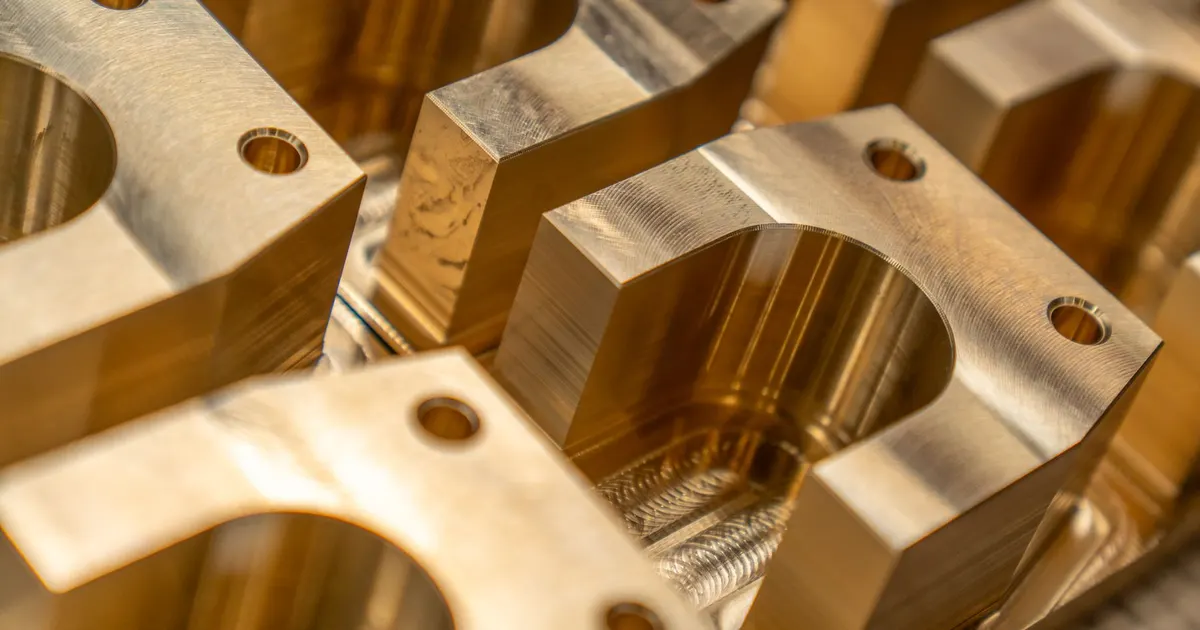
Seawater is hard on metal. Marine hardware for ships, boats, ports and shore stations is often made from copper alloys and nickel-copper alloys, because they resist corrosion and biofouling where steel and aluminum do not. Two families dominate: aluminum bronze and Monel. They look different on the price sheet and similar on the shop floor. This guide compares them, explains the machining and galvanic issues and shows what to write on the drawing for commercial and dual-use marine parts.
What the two alloy families are
Aluminum bronze is a copper alloy with roughly 9 to 11 percent aluminum, plus iron, nickel or manganese in the stronger grades. It forms a tough aluminum oxide film that protects the metal in seawater. It is strong for a copper alloy, wears well and resists cavitation and erosion in flowing water. Common grades are C63000 (nickel-aluminum bronze, wrought) and C95400 or C95500 (cast). Aluminum bronze resists fouling by marine growth to a degree, though not as completely as copper-nickel.
Monel is a trademarked family of nickel-copper alloys. Monel 400 (UNS N04400) has about 63 percent nickel and 30 percent copper, with iron and manganese. It resists seawater, many acids and alkalis and holds up at elevated temperature. Monel K-500 (UNS N05500) adds aluminum and titanium so it can be age hardened to much higher strength, which suits shafts, pump parts and fasteners.
Typical properties
| Property (typical) | Aluminum bronze C63000 | Monel 400 | Monel K-500 aged |
|---|---|---|---|
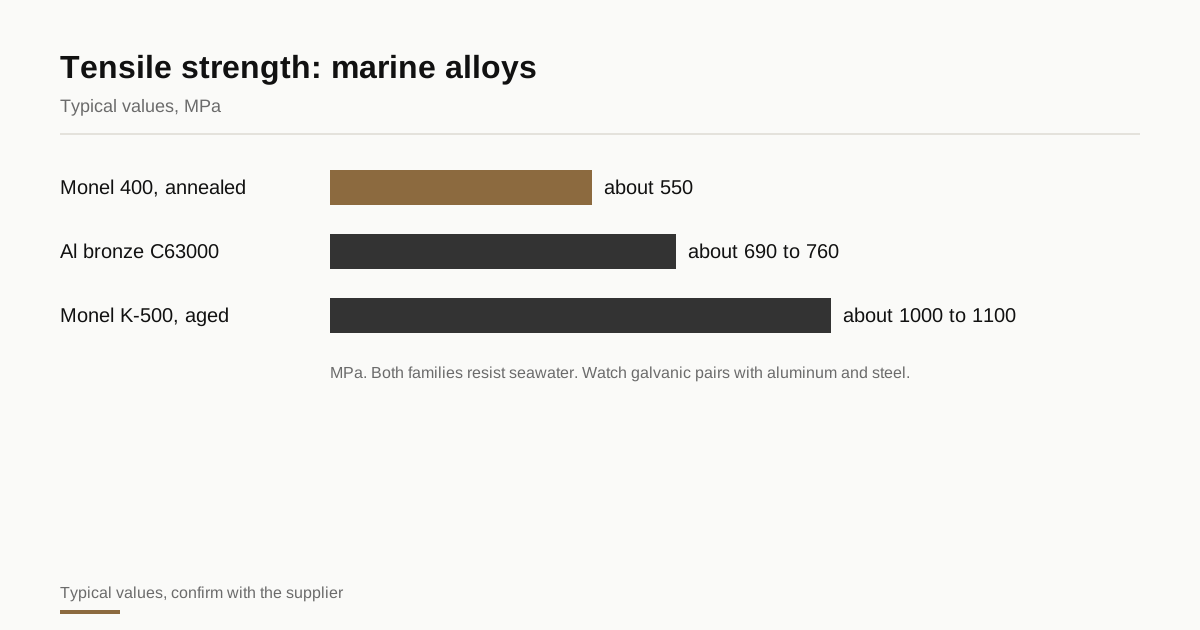
| Tensile strength | about 690 to 760 MPa | about 550 MPa annealed | about 1000 to 1100 MPa |
| Yield strength | about 345 to 480 MPa | about 240 MPa annealed | about 690 to 790 MPa |
| Density | about 7.6 g/cm3 | about 8.8 g/cm3 | about 8.4 g/cm3 |
| Seawater resistance | Very good | Excellent | Excellent |
| Machinability | Moderate, abrasive | Poor, work-hardening | Poor in aged state; machine soft |
| Relative price | Moderate | High | High |
Figures vary with product form and condition, so use the specification and the mill certificate for design values. For the specification, ASTM B150 covers aluminum bronze rod and bar, ASTM B164 covers Monel 400 rod and bar and ASTM B865 covers K-500 rod and bar. Cast aluminum bronze follows ASTM B148. Check the current revisions and any AMS or military document the drawing cites.
Where each is used
Typical marine and port hardware in these alloys includes:
- Pump impellers, wear rings and shaft sleeves.
- Valve bodies, seats and stems for seawater service.
- Fasteners, studs and threaded fittings.
- Propeller shaft parts, bushings and bearing sleeves.
- Hull penetration fittings, strainers and manifold parts.
- Winch and deck hardware.
- Instrument housings that sit in splash zones.
Aluminum bronze is the economical choice where strength and wear matter and where the chemistry is mainly seawater. Monel is the choice where the environment is more aggressive, where temperature is higher or where the part needs high strength with corrosion resistance, as with K-500. For commercial, dual-use and defense-adjacent hardware, the drawing names the alloy and the controlling specification.
Machining aluminum bronze
Aluminum bronze machines at roughly a fifth to a half of the speed of free-cutting brass. The alloy is strong and abrasive, and the hard aluminum oxide in chips wears tools. Practical guidance:
- Use sharp carbide tools with positive geometry and appropriate coatings.
- Keep feed steady and avoid dwell.
- Use flood coolant for finishing, or light cutting oil where the shop prefers it.
- Expect long, stringy chips on some grades, so chip breakers help.
- Cast parts need a clean skin cut. Hard inclusions at the cast surface wear tools quickly.
- Threading is best done by single point or thread milling for tight classes.
Aluminum bronze is not sparking in the way some steels are, which is a reason it appears in tools and fittings used near flammable materials. Check the safety standard that applies to your program.
Machining Monel
Monel is gummy and work-hardens fast. Light skimming cuts, rubbing and dwell create a hard layer that the next pass struggles to cut. Rules that work:
- Sharp, positive-rake carbide inserts, with a tool that cuts and does not rub.
- Constant, heavy enough feed so the tool always cuts under the work-hardened layer.
- Rigid setup and short tool stick-out.
- Plenty of coolant.
- Slow surface speeds compared with steel.
- Avoid stopping the feed in the cut.
For K-500, rough in the annealed or solution treated condition, age to strength, then finish with light cuts or grinding. Age hardening causes small dimensional changes, so leave a finish allowance. Thread parts before aging when practical, then check them afterward.
Both alloys cost more to machine than stainless steel. The quote should assume more tool wear and slower rates, and a supplier that quotes Monel at stainless prices is probably not planning for it.
Galvanic pairing: the part that causes field failures
Corrosion in seawater is often galvanic. When two different metals touch in an electrolyte, the less noble one corrodes faster. Aluminum bronze and Monel are noble metals. Paired with aluminum, galvanized steel or mild steel in seawater, the other metal suffers.
Practical rules:
- Do not fasten aluminum parts to aluminum bronze or Monel in a wet environment without isolation.
- Use insulating washers, sleeves and sealants at joints, or choose compatible hardware.
- Aluminum bronze and Monel are close to each other and to stainless steels in the galvanic series, so these pairs are usually acceptable.
- Large cathode, small anode is the worst case. A small aluminum fastener in a large bronze plate corrodes fast.
Name the mating material on the assembly drawing. A machined part is only as durable as its pair.
Specifying the callout
A complete callout for a marine part: “Aluminum bronze UNS C63000, rod, per ASTM B150, latest revision, mill certificate with heat number.” Add the temper or condition, since C63000 is supplied in several conditions, and the hardness range if required. For K-500: “UNS N05500 per ASTM B865, age hardened, hardness per specification.” For finish: “No coating. Passivate or clean as required.” Both alloys are normally used bare or with a protective topcoat on non-wetted areas.
Define the test and certificate requirements, such as PMI to verify nickel and copper levels, and ask for melt origin if the contract requires it. See material traceability for the records to request.
Heat treatment, hardness and condition
Aluminum bronze C63000 is supplied in several conditions, including as-extruded or as-drawn, and quench-and-temper or temper-anneal conditions that raise strength and hardness. The condition changes machining behavior, so the drawing should state it, along with the hardness range if the part sees wear. Cast grades such as C95400 are supplied as cast or heat treated to higher hardness. Hardness testing on a finished part is normal, with the test location named on the drawing.
Monel K-500 is the age-hardening member of the family. It is supplied annealed or solution annealed, then aged at a moderate temperature for several hours to reach full hardness. Aging causes a small dimensional change, so leave a finish stock allowance for parts with tight bores or threads. Monel 400 is not heat treatable and gets strength from cold work, so bar in different conditions has different strength. State the supplied condition on the drawing and check it on the mill certificate.
Export classification note
General marine hardware for commercial vessels is usually EAR99 or low-level CCL. Parts specially designed for military vessels can fall under 600-series ECCNs or the USML. The buyer classifies the part and holds any required licence. milcnc.com does not accept ITAR-controlled technical data and does not accept EAR-controlled data without the buyer’s licence. The export compliance policy lists what we match.
Sending marine parts for quoting
Send the STEP model and PDF drawing with the UNS number, product specification, condition, hardness and mating-material notes, plus quantity breaks and your export classification statement through the RFQ form. We sign an NDA, screen the package and match it with up to 3 CNC suppliers, with a focus on Vietnam. Quotes arrive within 24 business hours of a complete RFQ, and you contract directly with the supplier you choose. Related finishing and material choices for equipment parts are in the guide to ground support equipment machining.
Sources
General information, not legal or engineering advice. Check the current revision of every standard and clause.