4140 vs 4340 Steel for Defense Machined Parts: Heat Treat, Toughness and Cost
Key points
- 4140 is a chromium-molybdenum steel and 4340 is a nickel-chromium-molybdenum steel. The nickel gives 4340 deeper hardening and better toughness in thick sections.
- For small sections both reach similar strength after quench and temper. The difference shows in thick parts, low temperatures and fatigue-critical loads.
- 4340 costs more per kilogram, and aerospace-grade melt practices (vacuum remelt) cost more again.
- Both are heat treated, so tolerance, plating and hydrogen embrittlement relief must be planned together.
4140 and 4340 are the two low-alloy steels most often asked for when a defense drawing needs a tough, heat-treatable steel for shafts, pins, tow fittings, brackets and fixtures. They are close relatives. The difference is nickel: 4340 has it and 4140 does not. That one element changes how deep the steel hardens, how well it resists cracking under impact and what it costs. This guide explains when each is the right pick and what to put on the drawing so the supplier quotes the right material.
Composition and why it matters
Both steels contain about 0.4 percent carbon, plus chromium and molybdenum for hardenability and strength.
| Element | 4140 | 4340 |
|---|---|---|
| Carbon | about 0.38 to 0.43 percent | about 0.38 to 0.43 percent |
| Chromium | about 0.8 to 1.1 percent | about 0.7 to 0.9 percent |
| Molybdenum | about 0.15 to 0.25 percent | about 0.2 to 0.3 percent |
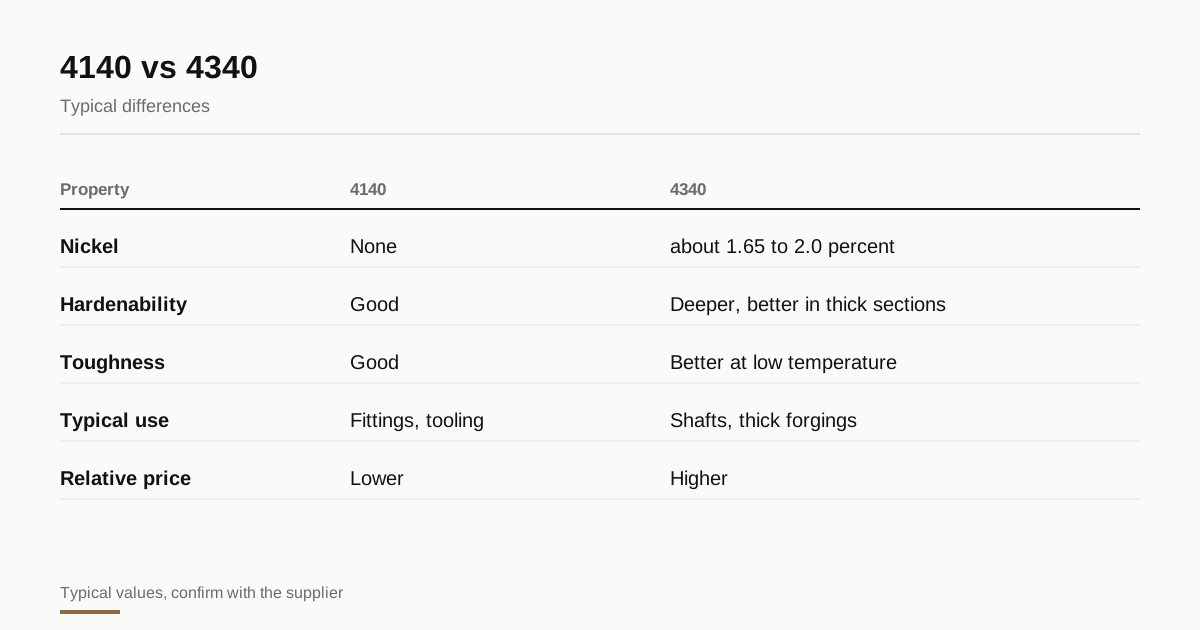
| Nickel | none | about 1.65 to 2.0 percent |
| Typical use | Shafts, fittings, tooling, general structure | Landing gear, high-load shafts, thick-section forgings |
Ranges are typical and the specification sets the real limits. Nickel does two things. It increases hardenability, meaning the quench produces a hard, martensitic structure deeper into a thick section. It also improves toughness, especially at low temperatures, so the part tolerates impact and notches better.
For a 25 mm bar, 4140 and 4340 can reach similar properties after quench and temper. For a 100 mm bar, 4140 may be hard at the surface and softer in the core, while 4340 stays closer to uniform. That is why 4340 is the choice for thick forgings and big shafts.
Typical strength levels after heat treatment
Both steels are supplied annealed or normalized and are heat treated by quenching and tempering. The tempering temperature sets the strength.
| Condition (typical) | Approx. hardness | Approx. tensile strength | Typical use |
|---|---|---|---|
| Pre-hardened or Q&T, soft end | 28 to 32 HRC | 900 to 1050 MPa | Machine after heat treat, structural brackets, fixtures |
| Q&T medium | 32 to 38 HRC | 1050 to 1250 MPa | Pins, fittings, tow eyes |
| Q&T high strength | 38 to 45 HRC | 1250 to 1500 MPa | Shafts, high-load pins, wear parts |
| Hardened and lightly tempered | 48 to 54 HRC | Above 1600 MPa | Rare, tooling or wear parts; low toughness |
Values are indicative. The drawing should state the condition as a hardness range or a tensile requirement, and the supplier’s heat treat certificate should show it was met. A drawing that says only “heat treat” is incomplete.
4140: the practical default
Choose 4140 when:
- The part is under about 50 mm in section, where hardenability is not a problem.
- The load is moderate and the part is not fatigue-critical.
- Cost and availability matter. 4140 is stocked widely in pre-hardened bar, plate and rounds, which makes lead times short.
- The part is a fixture, bracket or tow fitting where toughness at room temperature is enough.
Pre-hardened 4140 at around 28 to 32 HRC is a favorite for machining. It cuts well with carbide and is ready to use without further heat treat, which removes distortion risk and a process step.
4340: when it earns its price
Choose 4340 when:
- The section is thick and the core must reach strength.
- The part is fatigue-critical or impact-loaded: landing gear components, large shafts, high-stress pins.
- Low-temperature toughness is a requirement.
- The drawing calls for a particular AMS document, such as AMS 6415 (air melt) or AMS 6414 (vacuum remelted). Check the current revisions.
Vacuum arc remelt grades are cleaner. They resist fatigue and fracture better, which is why they are used where failure is costly. They also cost more, are sold in fewer sizes and have longer lead times. Do not specify them as a default. For a ground-support or fixture part, air melt 4340 or even 4140 is usually enough.
Material cost for 4340 is typically higher per kilogram than 4140, and the gap widens for aerospace melt grades. Exact differences move with the market, so quote both when the drawing allows either.
Heat treat sequence and tolerance
Two routes are common.
Route A, machine pre-hardened. Buy bar already quenched and tempered to 28 to 32 HRC, machine to final size and finish. No heat treat distortion, limited maximum hardness. Good for most structural parts.
Route B, rough, heat treat, finish. Rough machine in the annealed or normalized state, leaving stock (commonly 0.5 to 1.0 mm per side), heat treat, then finish machine or grind. Required for hardness above about 38 HRC. Slower and more costly, but it holds tight dimensions after the distortion has happened.
If the part is to be finish ground, the grinding stock allowance and the final surface finish go on the drawing. Hardened parts need stress relief after rough machining to keep distortion small, and the sequence should be named in the quote.
Give the supplier the heat treat specification (for example a standard for heat treatment of steel parts), the target hardness range and the test location. Ask for the heat treat certificate with the furnace record, and a hardness report from the finished parts.
Surface protection and hydrogen embrittlement
Bare steel rusts. Common finishes include black oxide (MIL-DTL-13924), phosphate, zinc-nickel and paint. For tow fittings and exterior parts, paint over phosphate or a plated base, with CARC if required. See the CARC coating guide.
Plating high-strength steel brings a risk. Acid cleaning and plating can put hydrogen into the steel, which can cause delayed brittle fracture in parts above about 1000 MPa tensile strength. The fix is a bake at around 190 C or as the specification requires, started within a short time after plating. Check the standard that applies to your program. If plating is on the drawing, add “hydrogen embrittlement relief per applicable specification” and ask for the bake record.
Cadmium plating, once common on steel hardware, is restricted by environmental rules. If an old drawing calls for it, ask the buyer about an approved alternative before quoting.
Specialty metals and traceability
Alloy steels such as 4140 and 4340 are specialty metals under some US defense contract clauses, and the origin of the melt can matter. Ask for a mill certificate with melt origin when the contract needs it. See DFARS specialty metals for how the rule is read.
Machining each grade
Both steels machine well in the annealed or pre-hardened states. Annealed 4140 and 4340 sit around 200 HB and cut easily with coated carbide. Pre-hardened bar at 28 to 32 HRC takes lower surface speeds and more rigid setups, but it is routine work for a shop with carbide tooling. Above about 38 HRC the work moves toward hard turning with ceramic or CBN tools and finish grinding, and the price moves with it.
Practical points a drawing can help with: call out generous radii at inside corners so the cutter does not need a tiny tool, avoid deep blind holes in hardened material, state the surface finish at bearing and sealing faces and specify thread class and whether threads are cut before or after heat treat. For long shafts, say whether straightness after heat treat is a requirement, because quenched slender parts distort and need straightening or finish grinding.
What to ask the supplier
Ask who performs the heat treat, whether the furnace is controlled to a recognized pyrometry practice and what record comes with each load. Ask whether the stock is bought pre-hardened or hardened after rough machining, and how the supplier checks hardness on finished parts. For 4340 ask which melt practice the stock source supplies, since air melt and vacuum remelted material carry different prices. For plated parts ask who bakes the parts, at what temperature and how soon after plating. Answers to these four questions say more about a supplier’s real capability than any list of machines.
Export classification note
The grade of steel does not set export control. The part’s design and end use do, and the buyer owns classification. milcnc.com does not accept ITAR-controlled technical data and does not accept EAR-controlled data without the buyer’s licence. See the export compliance policy.
Quoting steel parts
Send the drawing with the alloy, specification and revision, the heat treat condition, hardness range, finish, hydrogen relief requirement and certificate level written out. Add quantity breaks and your export classification statement through the RFQ form. We sign an NDA, screen the package and match it with up to 3 CNC suppliers, with a focus on Vietnam. Quotes come back within 24 business hours of a complete RFQ, and you contract directly with the supplier you choose.
Sources
General information, not legal or engineering advice. Check the current revision of every standard and clause.